

Every way to move OneDrive to Google Drive or Dropbox (2026)
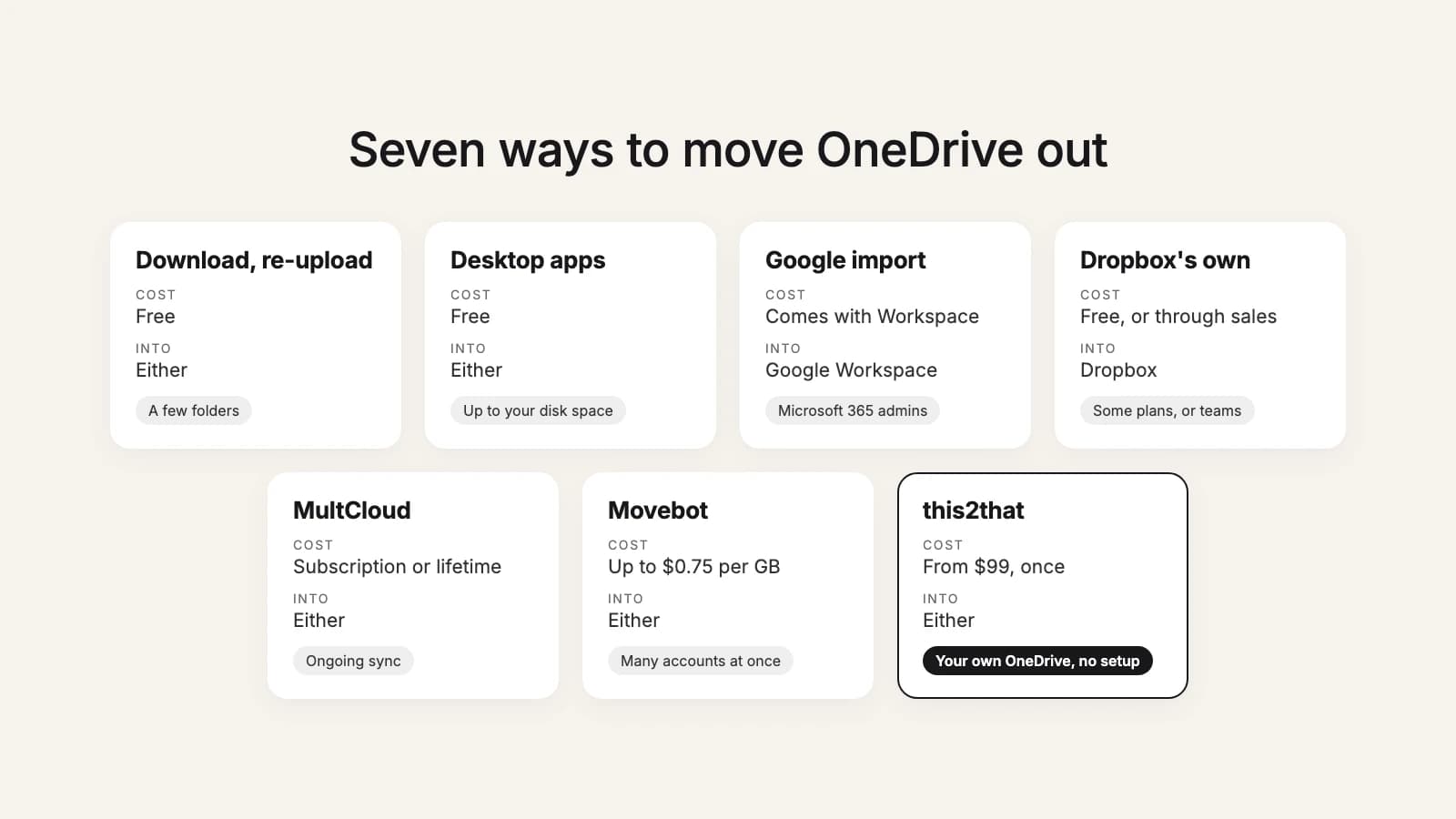
OneDrive has no "send to Google Drive" or "send to Dropbox" button, and Microsoft itself has no tool for moving out: its Migration Manager moves files into OneDrive and SharePoint, not out of them. Depending on how much you store, which kind of Microsoft account you have and where the files are going, the right way out is anything from a free download to Google's own admin tool. We make one of the options, so here's the whole field, including when another one is the better pick. Prices and features of other tools come from their own pages, as of October 2026.
| Option | Into | Cost | Who can use it | Runs on | Best for |
|---|---|---|---|---|---|
| Download and re-upload | Either | Free | Anyone | Your browser, twice over your connection | A few folders |
| The desktop apps | Either | Free | Anyone with the disk space | Your computer, which stays on | Up to what your disk can hold |
| Google's data import tool | Google Workspace | Comes with Workspace | Google super admin plus a Microsoft 365 Global Administrator | Google's servers | A company leaving Microsoft 365 for Workspace |
| Dropbox's Import from OneDrive | Dropbox | Free | Certain individual Dropbox plans | dropbox.com | Picking out a handful of files |
| Dropbox Data Migration Add-On | Dropbox team | Through Dropbox sales | Dropbox team accounts | Movebot, through Dropbox | An organization moving many accounts |
| MultCloud | Either | Free 5 GB a month, then from $19.99 a month or $59.99 a year | Anyone | MultCloud's servers | Ongoing sync between several clouds |
| Movebot | Either | Up to $0.75 per GB moved | Anyone, card needed before a transfer | Movebot's servers | IT teams and MSPs moving many accounts, SharePoint and mailboxes |
| this2that | Either | The first 5 GB or 200 files free, then from $99 once | Anyone with their own OneDrive, personal or work | this2that, cloud to cloud | One person moving their own OneDrive, without setup |
Two limits apply whichever option you pick. Into Google Drive, each account accepts 750 GB in 24 hours, so a 2 TB OneDrive takes at least three days to arrive. Dropbox says it has no daily upload limit, so there the limit is the tool and the number of files. The details are in how long it takes. And some things don't move with any method: OneNote notebooks as notebooks, the Personal Vault until you move files out of it, files other people shared with you, older versions and sharing. The list, with a fix for each, is in what doesn't move from OneDrive.
1. Download from OneDrive, upload to the new service
Free and needs nothing installed. Microsoft lists a 10,000-file limit, 250 GB per file, and 10 GB per zip (20 GB in all) when you download several compressed files such as zips or videos for downloading from OneDrive on the web, and everything travels over your own connection twice. Your folders come across; OneNote notebooks and the Personal Vault don't. Good for a handful of folders, painful beyond that. Steps in our guides to Google Drive and Dropbox.
2. The two desktop apps
Install OneDrive and Google Drive for desktop, or OneDrive and Dropbox, set the folders you want to Always keep on this device, and copy them across. Free, and your folders come across as they are. The catch is the computer: it needs free disk space for everything you move, and it has to stay on and online until the upload finishes at your upload speed. OneNote notebooks show up as shortcuts that open them on the web, so copying one gives you a link, not the notes.
3. Google's data import tool (Workspace admins)
Generally available since February 2025, Google's own tool imports OneDrive into Workspace for up to 500 people per run, each into their own Workspace account. A Google super administrator runs it, the Microsoft side has to be set up by a Microsoft 365 Global Administrator, and every person needs a Workspace license. It keeps files in their existing format, turns OneNote notebooks into folders and maps sharing permissions; it leaves out the Personal Vault and older versions. If you run Workspace for a company leaving Microsoft 365, it's the strongest option on this page, and Google lists no separate price for it. It needs a Microsoft 365 tenant, so it isn't an option for a personal OneDrive, a Microsoft 365 Family, Personal or Basic plan, or anyone who isn't the admin.
4. Dropbox's own options
On dropbox.com, the Upload menu can offer Import from Microsoft OneDrive: choose where the files go, connect your Microsoft account and select files. It's free, but Dropbox says it "may only be available on certain individual Dropbox plans", and it doesn't publish limits for it, so check whether you have it and try it on a few folders first. Good for picking out a handful of files.
For organizations, Dropbox sells a Data Migration Add-On, powered by Movebot, to Dropbox team accounts through its sales team. It moves files and their sharing permissions from other cloud storage into a Dropbox team. Dropbox's page doesn't name the services it moves from or publish a price, so ask your Dropbox account team; Movebot itself lists OneDrive among its platforms.
5. MultCloud
A web service that connects many cloud storage accounts, including personal OneDrive and OneDrive for Business, and copies or syncs between them. Its pricing page lists a free plan with 5 GB of data traffic a month, 100 GB a month for $19.99, 1,200 GB a year for $59.99, unlimited for $119 a year, and a lifetime unlimited plan for $249. A good fit if you want ongoing sync between several clouds, not just a one-time move. Most plans are a subscription, so remember to cancel once you're done.
6. Movebot
A pay-as-you-go migration platform, with a separate plan for managed service providers, covering files and mailboxes. Its list of platforms includes personal OneDrive, OneDrive for Business and SharePoint Online, Google Drive and Dropbox. Its pricing is $0.75 or less per GB moved, with free scanning and a card required before a transfer. At that rate 500 GB can cost up to $375. The right tool if you're moving dozens of accounts, SharePoint sites and email at once.
7. this2that
Ours. You sign in, connect OneDrive with read-only access, tick the folders and files you want, open the folder in Google Drive or Dropbox they should go to, and press the arrow. It runs cloud to cloud, straight from OneDrive to the other service, so you can close the tab. It works with personal accounts (Microsoft 365 Family, Personal, Basic or free) and with work or school accounts, though a work account often needs its IT admin to approve this2that first. It moves your own OneDrive: not SharePoint sites, and not files other people shared with you.
The first 5 GB or 200 files are free; after that a one-time pack covers the size you move, from $99 for 500 GB to $499 for 7 TB, and packs stack and never expire. Into Google Drive it pauses at Google's daily cap and carries on by itself. Into Dropbox, a file whose name is already taken arrives with "(1)" added, so nothing there is overwritten. You get a report of every file, which lists OneNote notebooks and shared shortcuts inside the folders you moved, you can retry failures, and for 30 days catch-up passes copy only what changed in OneDrive since. Nothing in OneDrive is changed or deleted.
When not to use us
- A few gigabytes: download and re-upload, Dropbox's own import if your plan has it, or the free allowance.
- You're the Workspace admin for a company on Microsoft 365: Google's data import tool carries permissions, with no separate price listed.
- SharePoint sites, Teams libraries, or dozens of accounts plus mailboxes: Movebot, or Dropbox's Data Migration Add-On if you're moving into a Dropbox team.
- You want two clouds kept in sync, not a move: MultCloud.
- You're only leaving because of the Family plan change: tidying up or adding storage may be cheaper. Our article on the 2 TB shared change weighs every option, including staying.
For everyone else moving their own OneDrive without tying up a computer for days, that's what this2that is for. Whichever you pick, the switch-over checklist covers what to do before, during and after.
Try it on your own OneDrive: the first 5 GB or 200 files are free.
See how it works→