

How to move OneDrive to Dropbox
Four ways to get your files from OneDrive into Dropbox, from a free download to cloud to cloud, with the steps for each and what to watch for.
Rather skip the manual steps? this2that moves OneDrive into Dropbox, cloud to cloud. The first 5 GB or 200 files are free.
See how it works→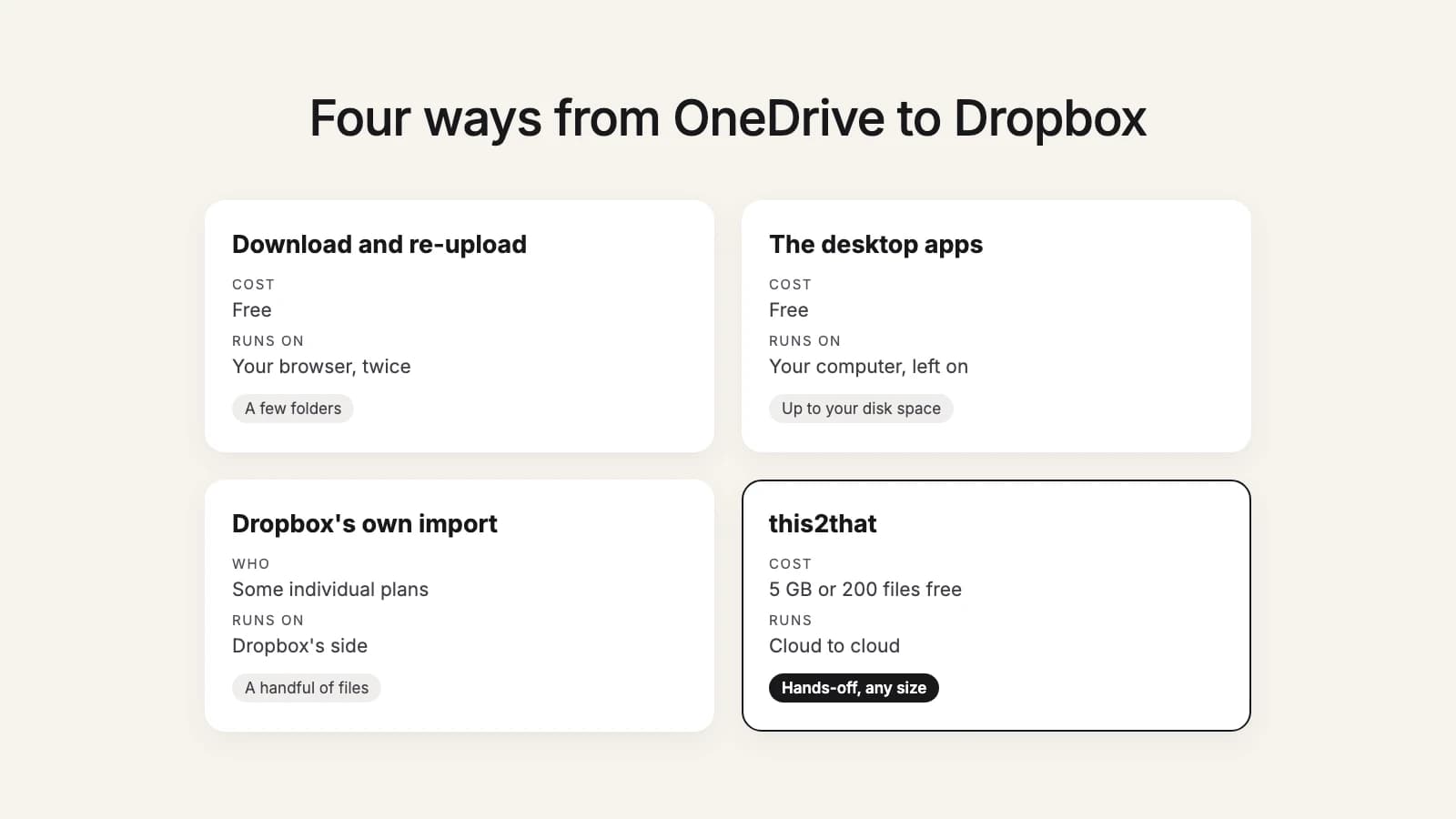
Before you start
- Know the size. Check how much you store in OneDrive, and make sure your Dropbox plan has that much free space.
- Decide where it lands. A folder such as "From OneDrive" keeps the move in one place while you check it. On a Dropbox team account, the team space holds your member folder and the team folders: personal files go in yours, shared work in the right team folder.
- Find your OneNote notebooks. A notebook is a package, not a file, so it doesn't move like your other files (see what doesn't move from OneDrive).
- Open the Personal Vault. Files in your Personal Vault sit behind a second sign-in. Move the ones you want to keep into a normal folder before you start.
Good news on timing: Dropbox says it has no daily upload limit, so a big move isn't held back to a set amount a day the way moves into Google Drive are. Leaving a Microsoft 365 Family plan because of the new 2 TB shared storage? That article lays out every option, including staying.
Method 1: Download from OneDrive, upload to Dropbox
Free, needs nothing installed, and fine for a few folders.
- On onedrive.com, select a folder and choose Download. OneDrive zips it.
- Unzip the download on your computer.
- On dropbox.com, open the folder where the files should go, choose Upload, then Folder, and pick the unzipped folder.
- Repeat for each folder, then spot-check a few files in Dropbox.
The limits: Microsoft lists a 10,000-file limit, 250 GB per file, and 10 GB per zip (20 GB in all) when you download several compressed files such as zips or videos for downloading from OneDrive on the web, and Dropbox accepts files up to 350 GB on dropbox.com. Everything crosses your connection twice, and the browser tab has to stay open while it uploads.
Method 2: The OneDrive and Dropbox desktop apps
Free, keeps your folders, and copes with more files, if one computer has room for all of it.
- Install the OneDrive app and the Dropbox desktop app, and sign in to both.
- OneDrive keeps files online until you open them (Files On-Demand), so right-click the folders you want to move and choose Always keep on this device.
- Wait for OneDrive to finish downloading them.
- Copy the folders from your OneDrive folder into your Dropbox folder. Dropbox uploads them in the background.
- Leave the computer on and online until Dropbox says everything is up to date.
The limits: you need free disk space for everything you move, and the upload runs at your upload speed. OneNote notebooks show up as small shortcut files that open the notebook on the web, so copying them gives you a link, not the notes.
Method 3: Dropbox's own import
On dropbox.com, the Upload menu can offer Import from Microsoft OneDrive: you choose where the files go, connect your Microsoft account and select files. Dropbox notes that the option "may only be available on certain individual Dropbox plans", and it doesn't publish limits for it, so check whether you have it and try it on a few folders first. It's free, and a good fit for picking out a handful of files.
Dropbox team accounts can buy a Data Migration Add-On, powered by Movebot, through the Dropbox sales team. That's aimed at an organization moving many accounts at once. Microsoft itself has no tool for moving out: its Migration Manager moves files into OneDrive and SharePoint, not out of them.
Try it now
A whole OneDrive, without your computer
this2that moves your OneDrive into the Dropbox folder you choose, cloud to cloud. The first 5 GB or 200 files are free.
Method 4: this2that, cloud to cloud
This is the tool we make, so weigh this section accordingly. It copies from OneDrive straight to Dropbox, cloud to cloud, so nothing passes through your computer and you can close the tab while it runs.
- Open OneDrive to Dropbox, sign in, and connect OneDrive and Dropbox. We ask Microsoft for read access only, so nothing in your OneDrive can be changed or deleted. Personal accounts connect straight away; a work or school account may need its IT admin to approve this2that first.
- On the left, tick the folders and files you want. On the right, open the Dropbox folder they should land in.
- Press the arrow. The move counts the files, then starts by itself.
- Come back whenever you like. Each move shows its progress, and its report (a CSV) lists every file that moved, was skipped or failed, with the reason.
The first 5 GB or 200 files move free. After that you buy a one-time pack for the size you move, $99 for 500 GB up to $499 for 7 TB, and packs stack for bigger moves. Failed files can be retried, and for 30 days after a move finishes a catch-up pass copies only what's new or changed in OneDrive since.
Which method should you use?
- A few files: Dropbox's own import, if your plan has it, or download and upload.
- Up to a few hundred gigabytes, and a computer with room for it: the desktop apps.
- An organization moving many accounts: Dropbox's Data Migration Add-On.
- A whole personal or family OneDrive, without babysitting a computer: a cloud-to-cloud tool such as this2that. Timing for each size is in how long it takes to move OneDrive.
Moving to Google Drive instead? See how to move OneDrive to Google Drive. More tools, including MultCloud and Movebot, are compared in every way to move OneDrive.
After the move
- Compare file counts and spot-check folders you know well.
- Save what you need from your OneNote notebooks.
- Share folders again in Dropbox: sharing in OneDrive doesn't come across.
- Replace OneDrive links in documents and bookmarks with Dropbox links.
- Keep OneDrive until you're sure nothing is missing, then tidy up or change your Microsoft 365 plan. Our switch-over checklist walks through before, during and after.